Home I About Us I Contact Us I Terms of Use I Privacy Policy I Site Map


The Lowdown on Hypereutectic Pistons
Written by Phil White - Posted October 19, 2019
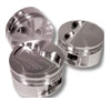
Hypereutectic (hy·per·eu·tec·tic) pistons are cast pistons made from aluminum with over 16% silicon content for strength and durability. The term
“hypereutectic” comes from eutectic.
Special melting processes are necessary to “super-saturate” the aluminum with additional silicon content. Special molds, casting and cooling
techniques are required to obtain finely and uniformly dispersed silicon particles throughout the material.
These newer pistons are very hard, thus brittle. They have proven to be unforgiving with engine knocking. For this reason they are great in naturally
aspirated engines, but should never be used when building a nitrous, supercharged or turbocharged engine. Generally speaking, forged pistons are
a much better choice for high boost engines.
Hypereutectic pistons are used in some original equipment engines. They are favored because of reduced scuffing, improved power, fuel economy
and emissions. The reduced thermal expansion rate allows the piston to be run with reduced clearance.
Advantages of Hypereutectic Pistons
In general I would say that most automotive engines use aluminum pistons in an iron engine block. The combustion chamber temperatures can
reach as high as 3800+ degrees Fahrenheit, but normal operating temperatures are approximately 1300-1800+ degrees Fahrenheit, and the coolant
is usually around 185-195 degrees Fahrenheit. As we all know aluminum expands more than iron at equal temperature ranges, so for the piston to
properly fit in the cylinder at a normal operating temperature, the piston must have a fairly loose fit when the engine is cold.
With ever increasing vehicle exhaust emissions in the mid-seventies the U.S. Government decided to form the Environmental Protection Agency
(EPA), which began creating and enforcing various rules and regulations that would require automobile manufacturers to undergo drastic changes
to make their engines operate much cleaner in regards to our environment. As time went by, vehicle exhaust emissions had noticeably improved,
but more stringent regulations would force vehicle manufacturers to adopt the use of electronic controlled fuel injection systems, OBD, and
hypereutectic pistons. It was discovered that during cold engine start-up, a small amount of fuel became trapped between the piston rings and the
piston lands. During engine warm-up, the piston would expand and allow a small amount of unburned hydrocarbons into the atmosphere.
With the addition of silicon to the piston's alloy composition, the piston expansion was greatly reduced. This allowed for much tighter engine
design tolerances between the piston and the cylinder wall. Silicon expands at a much lesser rate than aluminum does, but it also acts as an
excellent insulator, thus preventing the aluminum piston from absorbing as much of the operational heat as it otherwise would. Another useful
benefit of adding silicon to the piston alloy is that the piston becomes much harder and is less susceptible to scuffing and premature wear as
compared to a soft aluminum piston. In conclusion, a hypereutectic piston is very durable during high rpm, cold engine operation, and extreme
engine temperatures.
Advertisement
Media4Cars
covers
all
aspects
of
automotive
media,
including
new
cars,
motorsports,
auto
and
car
shows,
plus
everything
else.
We
offer
various
automotive
related
media
services,
including
articles,
photos,
web
content,
automotive event coverage, special automotive media assignments and more!

TM

Advertisement
The Lowdown on Hypereutectic
Pistons
Written by Phil White - Posted October 19, 2019
Hypereutectic (hy·per·eu·tec·tic) pistons are cast
pistons made from aluminum with over 16%
silicon content for strength and durability. The
term “hypereutectic” comes from eutectic.
Special melting processes are necessary to “super-
saturate” the aluminum with additional silicon
content. Special molds, casting and cooling
techniques are required to obtain finely and
uniformly dispersed silicon particles throughout
the material.
These newer pistons are very hard, thus brittle.
They have proven to be unforgiving with engine
knocking. For this reason they are great in
naturally aspirated engines, but should never be
used when building a nitrous, supercharged or
turbocharged engine. Generally speaking, forged
pistons are a much better choice for high boost
engines.
Hypereutectic pistons are used in some original
equipment engines. They are favored because of
reduced scuffing, improved power, fuel economy
and emissions. The reduced thermal expansion
rate allows the piston to be run with reduced
clearance.
Advantages of Hypereutectic Pistons
In general I would say that most automotive
engines use aluminum pistons in an iron engine
block. The combustion chamber temperatures can
reach as high as 3800+ degrees Fahrenheit, but
normal operating temperatures are approximately
1300-1800+ degrees Fahrenheit, and the coolant is
usually around 185-195 degrees Fahrenheit. As we
all know aluminum expands more than iron at
equal temperature ranges, so for the piston to
properly fit in the cylinder at a normal operating
temperature, the piston must have a fairly loose fit
when the engine is cold.
With ever increasing vehicle exhaust emissions in
the mid-seventies the U.S. Government decided to
form the Environmental Protection Agency (EPA),
which began creating and enforcing various rules
and regulations that would require automobile
manufacturers to undergo drastic changes to
make their engines operate much cleaner in
regards to our environment. As time went by,
vehicle exhaust emissions had noticeably
improved, but more stringent regulations would
force vehicle manufacturers to adopt the use of
electronic controlled fuel injection systems, OBD,
and hypereutectic pistons. It was discovered that
during cold engine start-up, a small amount of fuel
became trapped between the piston rings and the
piston lands. During engine warm-up, the piston
would expand and allow a small amount of
unburned hydrocarbons into the atmosphere.
With the addition of silicon to the piston's alloy
composition, the piston expansion was greatly
reduced. This allowed for much tighter engine
design tolerances between the piston and the
cylinder wall. Silicon expands at a much lesser rate
than aluminum does, but it also acts as an
excellent insulator, thus preventing the aluminum
piston from absorbing as much of the operational
heat as it otherwise would. Another useful benefit
of adding silicon to the piston alloy is that the
piston becomes much harder and is less
susceptible to scuffing and premature wear as
compared to a soft aluminum piston. In
conclusion, a hypereutectic piston is very durable
during high rpm, cold engine operation, and
extreme engine temperatures.
Advertisement

TM